







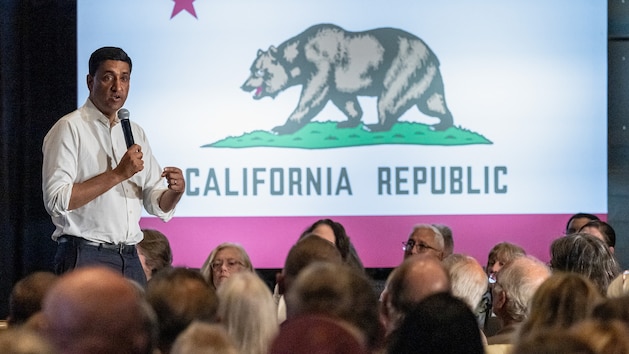
(WASHINGTON) -- Democratic Rep. Ro Khanna is unveiling an ambitious nearly $1 trillion proposal on Friday calling for universal childcare as he continues crafting legislative policies that may ultimately serve as the cornerstones of a potential presidential campaign in 2028.
"The biggest thing killing us is childcare," Khanna, who represents California, told ABC News in a phone interview while he crisscrosses the country campaigning for progressive candidates and reelection ahead of the midterm elections.
In an exclusive interview with ABC News, Khanna said he wanted to introduce a childcare bill before the high-stakes midterm elections as a "north star" and blueprint for "what we should be passing."
The Free Child Care for America Act is a nearly $1 trillion, 10-year package aimed at building a universal childcare system -- creating three taxpayer-funded pathways to provide flexibility and options for American families.
Khanna ticked off several potential spending reductions to offset the cost of the $1 trillion package -- such as savings realized by ending the war in Iran; $400 billion in new revenue collected by instituting a 5% "billionaire tax," or cutting the Pentagon's budget by $200 billion.
"What this childcare proposal -- in my view -- is speaking to [is] the needs of working class families, and it's something we can deliver," he said.
Khanna’s plan calls for billions of dollars that funds grants for states and tribal organizations to cover the cost of licensed childcare for eligible families, aims to increase the supply of childcare, support providers' operating costs, and raise compensation across the childcare workforce.
"If you want to do this right, it's going to be an $80 to $90 billion price tag," Khanna said. "That's what it takes to make childcare free. That's what it takes to pay people well, and that's what it's going to take to make it flexible."
His pitch comes as Vice President JD Vance has championed an administration proposal to expand federal childcare subsidies -- as much as $9,000 annually -- to married couples who have a stay-at-home parent.
Khanna said he believes families should be able to choose from a menu of childcare options.
"It should be value neutral between staying at home, going to a childcare center, or having friends or family, and that is maximizing the choice," Khanna said. "Vance's proposal is trying to tip the scales a bit on the choice of people who are stay-at-home parents."
Khanna explained his middle-class upbringing in Bucks County, Pennsylvania, motivated him to tackle the issue of childcare.
"Childcare is one of those things that didn't have the same exorbitant cost, and if we can fix that issue, provide people with childcare, you’re going to give more Americans the shot to have economic security in a modern economy, and that’s the whole point of economic patriotism: that people should be able to have economic independence in today's economy," he said.
The five-term congressman, whose net-worth is estimated to be in the hundreds of millions of dollars, explained how his own experience as a father of two children while working a demanding job has informed his perspective.
"I believe there's nothing more important than being there for kids at a young age, and I have an extraordinary wife who's an exceptional mom,” Khanna said. "It has given me an admiration for parents who do incredibly, incredibly hard work, and my view is that we've got to make it possible for parents who want to give their kids the best ability to do that."
Khanna says that his agenda -- which he has dubbed "America’s next new deal" -- is also informed through his conversations with families in swing states. Khanna has been holding town halls and participating in campaign events in swing states alongside progressive candidates.
"Economic patriotism is all about making the future economy work -- not just for the billionaires in my district, but work for the people I grew up with in Pennsylvania," he said. "As I traveled around the country, and I started with like, 'How do we bring good jobs?' I kept hearing, 'Well, that's fine, but how am I going to take care of our kids and do these jobs?'"
First elected to represent California’s 17th Congressional District in 2016 -- the same election President Donald Trump first won the White House -- Khanna has built a progressive voting record coupled with savvy media engagement. While Vermont Sen. Bernie Sanders has led the national progressive movement over the past decade, Khanna is striving to position himself as a potential successor -- though he is not breaking through any Democratic primary polls for 2028 so far.
Khanna's profile continues to grow as he engages with voters and weighs his future options -- sometimes even before Republican audiences on Fox News or in GOP-held districts. Last year, he laid out a political reform agenda focused on combating corruption -- hoping it would form the basis of the Democrats' platform in the upcoming midterm elections. He also took center stage alongside GOP Rep. Thomas Massie in the congressional effort to force the Department of Justice to release tens of thousands of records related to its investigation of Jeffrey Epstein.
Ahead of the midterms, Khanna continues to campaign on behalf of candidates across the country -- though he's not coy about his political ambitions.
"I want 2028 to be a big-ideas primary," Khanna said. "I want it to be a contest on who's going to have ideas of the future that meet the moment where many Americans feel that the economic and political system are broken and not working for them."
Khanna concedes that some stakeholders and supporters alike have expressed concern over the $1 trillion cost of his proposal, which would offer $1,000 per month to eligible stay-at-home parents with an eligible child under age 3 and a household income at or below 100% of their state's median income. But he says he is being transparent about the cost and argues that his package is worth the investment.
"Why would you think that giving entrusting the care of young people at their most impressionable, where their experience is going to shape the rest of their lives, and we have data showing that? Why would we think that that's cheap?” Khanna said. "Of course, it's expensive, and that's why there's this huge market failure because it's expensive, and yet people aren't being paid appropriately, and that's why it's a public good. And so this is really saying, OK, if you want to do this right, it's going to be a $80 to $90 billion price tag. That's what it takes to make childcare free."
House Democratic leaders have not endorsed Khanna’s childcare legislation, but agree that lowering childcare costs must be a priority if they take back the House majority.
"I want it to be front and center in the conversation of the first 100 days for the speaker," Khanna said regarding Democratic prospects to win the House majority. "Even if they don't do the whole $90 billion, I mean, obviously that's my hope that the House should pass this bill, they can take three elements of it."
As for the 2028 presidential race?
"Whether I run, which obviously I'm considering, or whether I am actively supporting other candidates, I want to be leading in putting forth bold ideas about what that Democratic Party should be," Khanna said. "I think we need to offer a new vision of ideas that are actually going to deliver for working- and middle-class families who have been left out."
Copyright © 2026, ABC Audio. All rights reserved.