







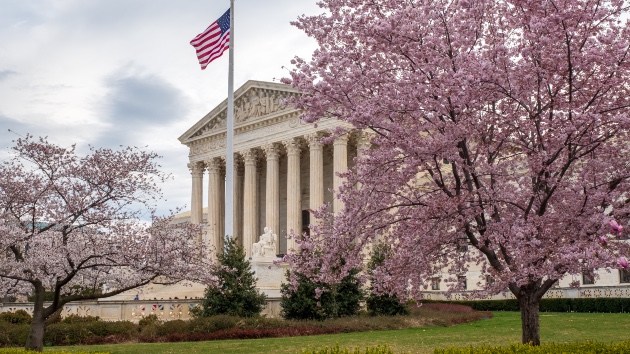
(WASHINGTON) -- In a ruling with direct bearing on the midterm elections, the Supreme Court on Monday narrowly upheld a Mississippi law allowing tabulation of late-arriving mail-in ballots so long as they were postmarked by Election Day.
Justice Amy Coney Barrett, writing for the 5-4 majority, wrote that federal election statutes -- which say nothing about ballot receipt -- do not override states' ability to set their own policies for handling tardy votes by mail.
"The Framers recognized the difficulty of crafting election laws applicable to every probable change in the situation of the country. So instead of constitutionalizing election law, they decided that a discretionary power over elections needed to be lodged somewhere. Suffice it to say, that power was not lodged in this Court," Barrett wrote.
The decision is a loss for the Republican Party, which brought the case, and the Trump administration, which has pushed to override state election rules nationwide by imposing strict federal limits on voting by mail.
The president on Monday called the Supreme Court’s decision a "tremendous loss" and again called on Congress to pass the SAVE America Act, his signature election and voting reforms legislation.
Senate Majority Leader John Thune has repeatedly said there aren't enough Republican votes for it to pass.
The 29 states that currently accept some timely cast but late-arriving mail-in ballots -- sometimes up to several days after polls have closed -- will be able to continue providing a grace period.
In dissent, Justice Samuel Alito, joined by Justices Clarence Thomas, Neil Gorsuch and Brett Kavanaugh, wrote that the decision flouts the meaning of "election day" as set forth in federal law.
"Not only is today's decision inconsistent with statutory text, legal context, historical practice, and precedent; it also threatens to produce lamentable consequences," Alito wrote. "The majority's holding spawns a slurry of troubling election-law questions and risks further undermining Americans' confidence in election integrity."
The outcome is a win for Mississippi, which had defended its policy of accepting ballots up to five days after voting had ended, and voting rights advocates who had argued that decades of legal precedent supported the primary authority of states to run their own elections.
Voters heavily reliant on the U.S. Postal Service, such as rural, overseas and disabled voters, had feared a higher risk of having ballots rejected if delivery is delayed, election watchdog groups said.
Lateness is the primary reason mail ballots are rejected nationwide, according to the U.S. Election Assistance Commission (EAC).
During the 2024 election, 28 million mail ballots were cast in the 14 states with postmark deadlines and grace periods, according to EAC. Roughly 725,000 were not counted because they were late.
The Supreme Court ruling comes as Trump has pushed aggressively to increase federal oversight of mail-in voting.
A Trump executive order signed in March 2026 would require states to submit approved voter lists to the U.S. Postal Service, which in turn would be tasked with ensuring ballots are only delivered to eligible residents.
Last week, Federal District Court Judge Indira Talwani of Massachusetts put the order on hold, writing in her decision, "The Constitution reserves the power to determine voter eligibility to the States alone. Neither the Executive Branch nor Congress may interfere with this power."
The Postal Service has not yet implemented a proposed policy change to comply with Trump's order, but a top USPS official confirmed to Congress that his agency would refuse to deliver ballots unless states turn over lists of voters.
"No law enacted by Congress delegates authority to control mail-in voting to USPS. The voting-related guidance currently issued by USPS is not binding on the States, merely recommended," Talwani’s ruling said.
Copyright © 2026, ABC Audio. All rights reserved.