




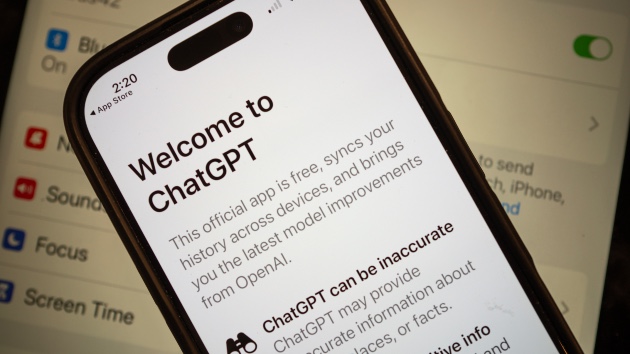
(NEW YORK) -- Recently released polling on Americans' opinions of artificial intelligence gives us an updated look at how people are interacting with AI, what they are using it for and whether they are skeptical of the technology.
About half of American adults (49%) said that they have used chatbots like ChatGPT, Gemini or Copilot before, up from 33% in 2024, according to a Pew Research Center report released Wednesday.
The study found 42% of adults who used chatbots used them to search for information, 38% used it for work tasks, 25% for fun or entertainment, 24% for creating or editing images or videos, 20% for medical advice and another 20% for diet and fitness information.
About a quarter of Americans -- 24%-- said they used chatbots daily, according to Pew.
The Pew study found that, overall, while Americans under 50 years old were more likely than those 50 and older to use chatbots, use has risen over time among adults of all ages. And while men and women both use chatbots at roughly the same rate overall, more men use chatbots on a daily basis than women.
The share of Americans using AI bots for advice and information on health has also increased. A KFF study released Wednesday found that 29% of Americans said they used AI tools or chatbots at least monthly for information and advice on health, up from 17% in 2024.
Most of these users, 56%, are confident they can determine what is true and what is false when accessing health information on chatbots. Younger adults were more confident than older adults.
Still, Americans are skeptical of AI chatbots.
Pew found that more Americans (40%) said that AI will have a negative impact on society over the next 20 years while only 16% said it will have a positive impact. Americans are also more negative on AI's impact on themselves: 31% said it will have a negative impact over the next 20 years rather than a positive one (23%).
Younger adults are more wary about the impacts that AI will have on society and themselves than older adults, according to Pew. Nearly half of adults under 30 (48%) believe that AI will have a negative impact on society, compared to 39% of those 30 to 49 and 37% of those 50 and older. While 37% of adults under 30 said the impact on themselves will be negative, that falls to 30% among those 30 to 49 and 28% of those older than that.
Americans largely think AI is moving too fast: A 63% majority of adults said that AI is advancing too quickly, according to Pew, while 19% said it was moving at the right pace and just 2% said it was moving too slowly.
Americans are also concerned about personal information and AI. Pew found about 7 in 10 adults (71%) said that the use of AI will make personal information less secure.
While Americans don't trust big tech or AI companies to do what's best, they also don't trust the government to keep them in check.
A CNN poll, also released Wednesday, found 69% of Americans saying they trust companies developing AI tools "a little" or "not at all" to do what is best for their users.
Pew found a similar share of Americans voicing skepticism that the U.S. government will regulate AI effectively (67%).
Democrats have become less confident in the government regulating AI. In a 2024 Pew Research Center poll, 54% said they had not much or no confidence in the government regulating AI effectively, rising to 74% in the new Pew poll. Republicans' lack of confidence has declined over the same period from 70% to 61%. This divergence in the views of Democrats and Republicans over time may be because there was a Democratic president in 2024 and a Republican president now.
The Pew Research Center poll was conducted Feb. 17-23 among 5,119 U.S. adults with an error margin of +/- 1.6 percentage points, including 2,605 AI chatbot users with an error margin of +/- 2.2 percentage points.
The KFF poll and the CNN poll were both conducted May 7-31 among 2,480 U.S. adults and have an error margin of +/- 2.7 percentage points.
Copyright © 2026, ABC Audio. All rights reserved.