






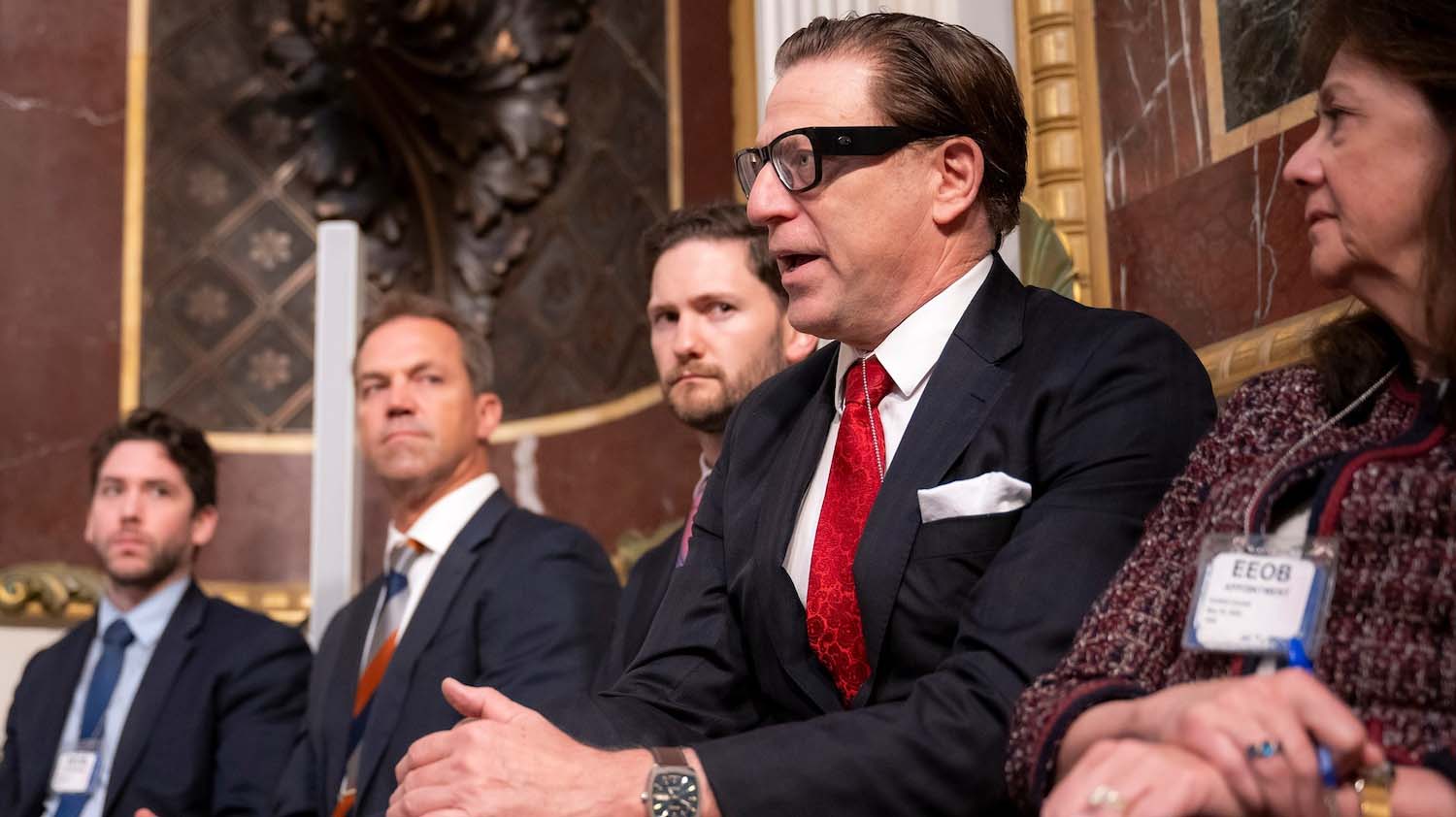
(WASHINGTON) -- The former acting Federal Emergency Management Agency (FEMA) administrator said that Texas got the help it needed during the historic and deadly flooding over July Fourth weekend last year, despite criticism heaped on the agency's response, according to a new book set for release on Tuesday.
In the book, titled "Texas Flood: Power, Money, Politics, History, Bureaucracy and Tragedy," David Richardson also outlined what he believed to be the source of former Secretary of Homeland Security Kristi Noem's downfall as well as discussing the Trump administration's plans to restructure the agency.
"I prepared for the worst from the minute I got to FEMA, and a worst-case scenario did happen and we were able to effectively maneuver around obstacles to make sure that the people of Texas got what they needed in their time of need," Richardson told ABC News in an interview. He said the agency prepared for worst-case scenarios "though a series of planning efforts and exercises."
Democrats accused DHS of being slow on the response efforts in Texas. DHS did not immediately respond to a request for comment.
Richardson resigned from FEMA abruptly in December 2025.
At the center of that decision was a memo put by Noem requiring that every contract above $100,000 must be personally signed off by her.
"I eventually had to make a decision where I overrode DHS headquarters and sent the support anyhow," Richardson said, referring to Texas. "I knew the magnitude of the problem when I started looking at the low end of $500 million a day we're going to have to write contracts for. If I'm going to have to have everyone over $100,000 approved by headquarters, that's just another layer of bureaucracy."
In the book, Richardson paints the picture of Department of Homeland Security putting put "spies" at FEMA headquarters, to see what he was doing, and a secretary concerned with her appearance more than actually getting work done.
Richardson recounts in the book one of his employees saying the memo would "kill" them during a disaster. A former Marine, Richardson said he viewed getting lifesaving support to Texas as essential, regardless of the cost.
"When a Marine or an Army ranger calls for support, they get what they need, regardless of the cost," he said. "That's how I viewed getting support during hurricanes or as it came to be during the flash flood in Texas."
In practice, the cost saving measures were well intentioned, he said, but "he downstream effects of that memo...were never really considered."
"I firmly believe that the 100K memo and the ramifications that it had was the beginning of the end for Secretary Noem," he said.
Typically, FEMA administrators are on the ground immediately after a natural disaster strikes, but Richardson didn't go to Texas immediately because he believed the "greatest point of friction" was in DC.
"I was going to go to Texas once the check was cashed," he said. "I wasn't going to Texas and tell them the check is in the mail. I made sure it was cashed before I went there to see the people of Texas."
Richardson also detailed in the book how he spent one night in Gettysburg, Pa. when the floods hit over July Fourth weekend, and raced back to D.C. the morning after. He took criticism during his testimony by House Democrats, but outlined in his book that he worked throughout the trip.
In the book, he detailed the exercises FEMA ran to prepare for a disaster, including modeling what would happening during a Category 3 hurricane - which would cost hundreds of millions of dollars to respond to.
Richardson told ABC News it was "not true" that FEMA withheld essential support from Texas, and that there were already FEMA teams on the ground to respond to the floods, including a FEMA team in Denton and utilizing the Coast Guard for search and rescue.
"The tragedy was, so many people died and the search and rescue teams had to get to Texas so they could recover the bodies," he told ABC News.
Richardson said he realized that once his plan to reshape the agency wasn't going to be considered and instead had to be worked through the FEMA review council, set up to recommend the future of the agency, he decided to resign.
The FEMA Review Council's recommendations, the body which advised the DHS of reducing the size of the agency in DC don't go far enough he says, and in the book he argues FEMA should not be under DHS, but report directly to the president.
"I realized OK, I'm just here for hurricane season," he said. "And once hurricane season is over, I'm done because I don't want to be in charge of a bloated Inefficient agency like FEMA that I can't put on a diet."
He called the agency "bloated, overweight and unhealthy," and wanted to put FEMA "on a diet," by reducing the number of employees at FEMA headquarters.
Michael Coen, the former FEMA chief of staff in the Biden and Obama administrations told ABC News that FEMA is a critical organization that supports people on their worst days.
“FEMA’s structure has been built to align the necessary resources and staff to address the risks the nation may face,” he said in response to Richardson’s critiques of FEMA being a bloated agency. “The Agency is continuously improving and learning to meet the mission.”
Copyright © 2026, ABC Audio. All rights reserved.