






(NEW YORK) -- A nationwide wave of protesters and vandals targeting surveillance cameras made by Flock Safety did not deter a man in a Darth Vader costume from praising the devices at a recent city council meeting in San Diego, California. His "Star Wars"-themed acclaim, as it turned out, was anything but.
"The Emperor is a fan of Flock," the man told elected officials in a mocking tone last week. "We must continue utilizing Flock technologies so that we can follow and surveil the rebel scum."
So far this year, more than 50 cities and counties have canceled or deactivated automated license plate-recognition (ALPR) cameras of the type manufactured by Flock Safety and other firms, also known as Flock cameras, Politico found.
On Monday, Florida's state transportation office revoked the ability of local law enforcement to put license plate readers on state highways.
Flock cameras have been vandalized in at least 36 states, including incidents in which individuals sawed down the devices and shot at them with guns, NPR reported last month.
The neighborhood cameras have prompted pushback in localities big and small, dotting red and blue states. Privacy concerns have been stoked in part by instances of police officers tracking ex-partners or other relations, some analysts and advocates told ABC News.
Wariness about the role of artificial intelligence in the technology has deepened public unease, tapping into discontent about the possibility of AI acting beyond human oversight, they added.
"This is the biggest, most grassroots privacy backlash that I've ever seen in more than 20 years working on these issues," Jay Stanley, a senior policy analyst at the American Civil Liberties Union's Speech, Privacy, and Technology Project, told ABC News.
"It just shows people don't like mass surveillance," Stanley added.
Surveillance technology firms and a law enforcement expert, however, touted the cameras as a valuable tool for police departments, leaving officers better equipped to protect public safety.
"You can see in some cases unsolved crimes may have been solved if there were a Flock camera in the area at the time," Kenneth Gray, a lecturer in the Criminal Justice Department at the University of New Haven, told ABC News. "They can be useful."
More than 135,000 automated license plate-recognition cameras have been identified nationwide, and four of every five of those are made by Flock Safety, according to crowdsourced data from DeFlock.org. The company says its cameras operate in 49 states.
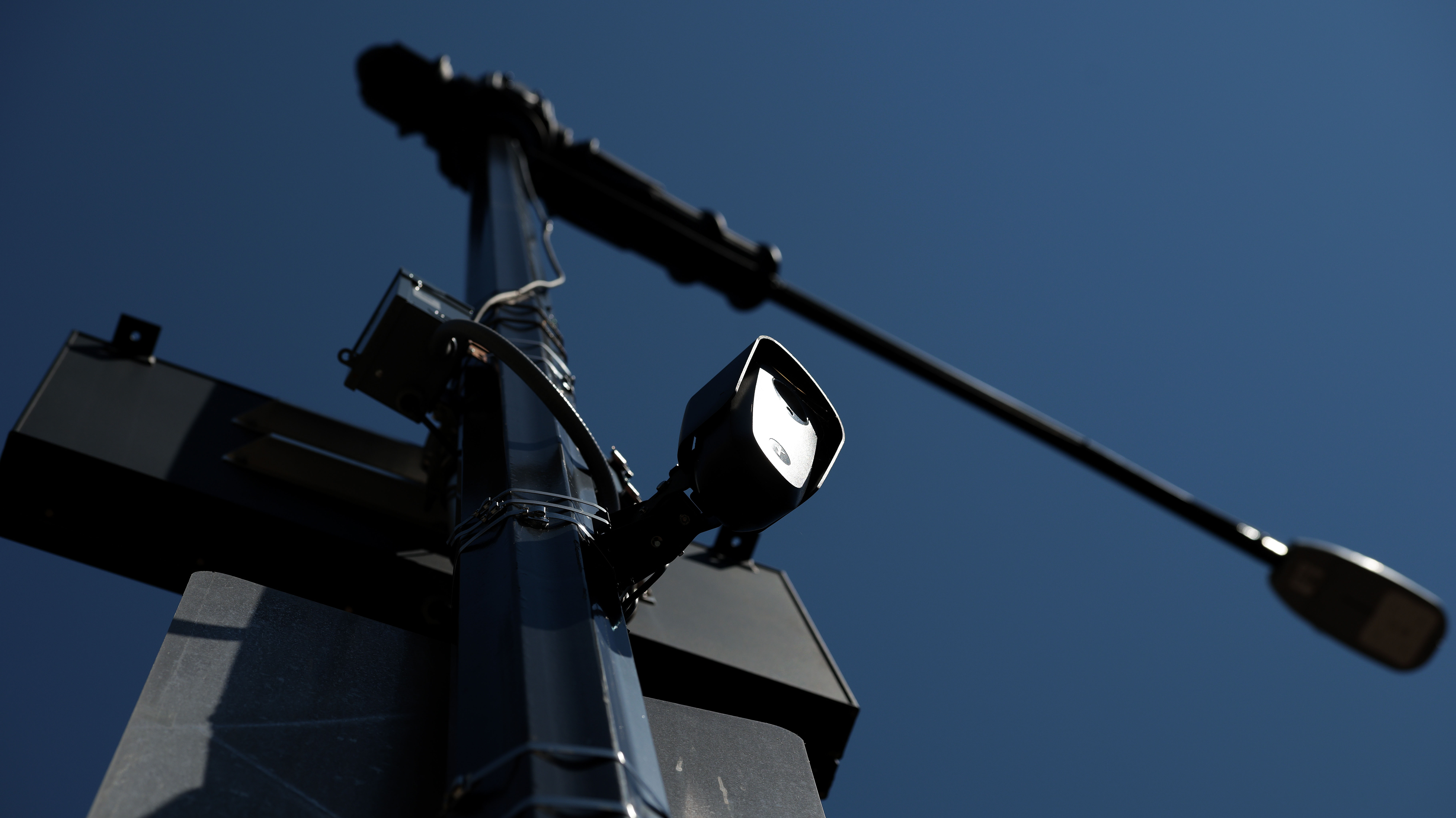
Flock cameras, which sit atop metal roadside poles resembling streetlights, capture a vehicle's license plate number and characteristics as it passes, Flock Safety says on its website. The devices do not identify individuals in a given car, nor do they record continuously, the company adds.
Earlier this month, the firm bolstered safeguards for its cameras, including a default data-retention period of seven days instead of 30, as well as an "Evidence Mode" for preserving data related to an active investigation.
"Flock is designed to help authorized users find relevant evidence for investigations without compromising safety and compliance," the Flock Safety website says. "Clear safeguards define how information is stored, accessed, shared, and reviewed."
Flock Safety did not immediately respond to ABC News' request for comment.
The technology has triggered some police abuse involving its recordings. A police officer in Kentucky was arrested last week after authorities alleged he used Flock cameras to track his ex-girlfriend more than 2,000 times. In Savannah, Georgia, six police department employees were fired in August over alleged abuse of Flock cameras, according to local ABC affiliate WJCL.
The nonprofit Institute for Justice, a libertarian law firm, says it has identified more than 100 incidents of ALPR abuse, among them stalking and wrongful stops.
"People have a sense, 'I wouldn't want someone following me around in a car; and I wouldn't want them doing it with a camera,'" Evan Greer, director of Fight for the Future, an advocacy group organizing against Flock cameras, told ABC News.
"Then when these stories come out about law enforcement officers using it to stalk their exes, it reminds people once you build a surveillance apparatus like this, it can and will be abused," Greer added.
The use of AI in Flock cameras has exacerbated concern among some critics, analysts said, since they fear data could be compiled and examined by the technology with limited oversight.
"These companies are not just recording that you were on this street at this time on this day; they're also allowing law enforcement to run algorithms to decide whether your movement patterns are 'suspicious,'" said Stanley, of the ACLU.
Surveillance companies and a law enforcement expert promoted the crime-fighting benefits of Flock cameras. They pointed to the unique information provided by a network of devices that can identify and track vehicle movements.
Flock Safety says it helped authorities locate more than 10,000 missing people last year, amounting to more than 27 per day. Roughly 1 million criminal investigations were supported by Flock in 2025, the company says.
Flock Safety cameras helped law enforcement identify the car belonging to a suspect in the murder of a Brown University professor last year, aiding efforts to track down the individual, Providence Police Chief Oscar Perez said in December. The suspect died by suicide before he was located.
The surveillance capability that unnerves some critics can be vital to a police investigation, according to Gray, of the University of New Haven.
"Because there's a series of Flock cameras, you can put together a pattern of where a particular car goes at a certain time of day along a particular route," he said. "That can be useful in putting together details that can be analyzed to try to fill in gaps for an investigation."
Still, Gray acknowledged, the camera system collects information on many innocent people, vacuuming up data of no utility for law enforcement.
"The Flock system is building a database without any allegation of criminal activity. It's useful to law enforcement after the fact, but it's also gathering up information on many people that have committed no crime," Gray said.
Critics of Flock cameras lauded local efforts to cancel or alter contracts with surveillance companies. They said they hoped additional restrictions would be implemented on a wider scale.
Greer, of Fight for the Future, advocated for a nationwide ban of the technology, saying "there are certain types of weapons we've decided as a society are too dangerous to sit in the basement of your local police department."
Torin Monahan, a professor at the University of North Carolina at Chapel Hill who specializes in surveillance, said law enforcement should be required to possess a judicial warrant in order to access Flock camera data.
"If they have to prove probable cause and protect people's 4th Amendment rights, as they do with other evidence, I think that would be reasonable," Monahan told ABC News.
Gray, the law enforcement expert, agreed.
"A warrant for the information from the database would protect the public from misuse," he said.
The backlash has prompted action from state and national elected officials belonging to both major parties.
Republican Texas Gov. Greg Abbot last week paused state funding of Flock cameras. Meanwhile, Democratic Pennsylvania Gov. Josh Shapiro said in recent days he would welcome a bipartisan bill to ban Flock cameras in the state.
Sen. Josh Hawley, a Missouri Republican, on Friday announced an investigation into Flock Safety, penning an open letter to the company that included a request for internal documents.
"I want law enforcement to have tools to catch offenders and keep the public safe. But Americans do not surrender their privacy rights when they drive to work, drop their kids off at school, or go to church," Hawley wrote.
Copyright © 2026, ABC Audio. All rights reserved.