







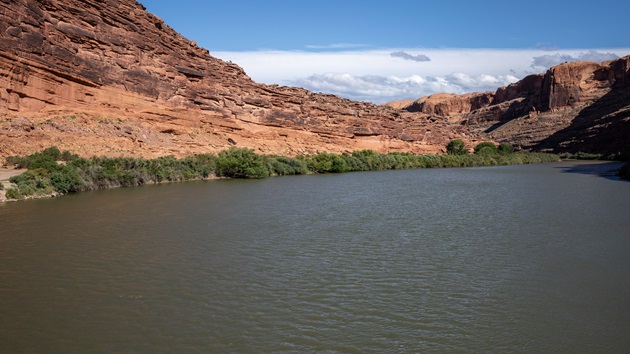
(NEW YORK) -- The Colorado River basin and its two largest reservoirs -- Lake Mead and Lake Powell -- are facing potentially record-low water levels in the coming months due to a snow drought that impacted much of the West over the winter season, projections from the U.S. Bureau of Reclamation show.
The 24-month study released by the Bureau of Reclamation, which oversees water resource management, on Friday indicates that Lake Mead could reach a record-low level of 1,036 feet of elevation in 2026.
Lake elevations indicate how much water is inside a reservoir. The Bureau's scenario analysis looks at the end of month elevations for both Lake Powell and Lake Mead, and they make a future projection based on the probable inflow.
The previous low at Lake Mead was recorded in 2022, when levels dropped to around 1,040 feet.
Lake Mead could again approach these critically low levels over the next several months and years, according to the Bureau. This would depend on both the climate conditions as well as the response to those conditions, Dave White, director of the Global Institute of Sustainability and Innovation at Arizona State University, told ABC News.
Lake Powell is also projected to drop to a new record-low level in the coming months, surpassing the previous record of around 3,520 feet set in 2023. The amount of water flowing into the lake between April and July is forecast to be around 800,000 acre-feet, the lowest flow on record and only 13% of the average for that period, Cody Moser, senior hydrologist at the Colorado River Basin Forecast Center, said during a webinar on May 7.
Lake Mead and Lake Powell are the largest reservoirs in the U.S. Together, they store about 80% of the water supplies in the Colorado River system, Mark Squillace, professor of natural resources at the University of Colorado, told ABC News.
More than 40 million people rely on the river system for water, according to the Bureau.
Apart from actual water supplies, one of the biggest concerns for hydrologists is whether enough water remains in the reservoirs to operate hydropower systems. Another 2.5 million people are supplied by hydropower conducted in the Colorado River's hydroelectric facilities, such as the Hoover and Glen Canyon dams.
The minimum surface elevation needed to generate power at the Hoover Dam is 1,050 feet, according to the Bureau. Anything below that is considered "inactive pool," and a "dead pool" exists at 895 feet in elevation.
A "dead pool" is when water won't flow to a dam and is too low to flow downstream.
Record low snowpack was followed by a heat wave in March that served as a "knockout punch" for lack of runoff leading to the reservoirs, Jon Meyer, assistant Utah state climatologist, told ABC News.
"We've been monitoring how the dismal thin snowpack melts travel down through the watersheds, and how much reservoir recharge and stream flow we can expect this year," Meyer said. "It is just exceedingly underperformed a normal situation."
But this isn't a situation caused by one bad snow year, Arizona State University's White said, adding that the Colorado River system is operating under an increasingly warmer, drier climate.
The West had been dealing with a decades-long megadrought before atmospheric rivers in the winters of 2023 and 2024 inundated the region with enough moisture to cause extreme flooding and alleviate drought conditions. This is further evidence of hydroclimate whiplash -- the rapid shift between wet and dry conditions -- that has resulted from anthropogenic climate change, the experts said.
"This is a multi-decade-old drought, and then on top of that multi-decade-old drought are the impacts of climate change, which predominantly translate into higher temperatures, more variable precipitation, and drier soils and higher [water] demand," White said.
The most recent low reservoir levels occurred in 2022, in which Lake Mead's water levels reached a record low of around 1,040 feet, according to the Bureau of Reclamation.
After that year, reservoir levels rebounded slightly due to aggressive conservation measures, especially from the lower basin states -- Arizona, California and Nevada, White said.
The Colorado River system is integral for supplying water, power and watering the agricultural feeds that sustain the rest of the country, Erica Fleishman, director of the Oregon Climate Change Research Institute said.
But the river system is over-allocated, according to Fleishman. The water rights were established during a period of the 20th century in which levels were "unusually high," she noted.
"The Colorado River is emblematic of what the entire West is seeing this year with limited water supply and ramifications for hydropower generation, for irrigation, for water quality," Fleishman said.
The Bureau is anticipated to issue a record of decision with the operational guidelines for 2027 and 2028, as well as a framework for 2029 through 2036.
The lower basin states have submitted an allocation plan for consideration, but there is not yet a consensus plan among all of the states, including the upper basin states, according to White.
"I think it's fair to say no one is happy with it," he said.
Copyright © 2026, ABC Audio. All rights reserved.